Igbinobaro v. Dominion of Canada (Travelers)
When Your Story Changes Every Time You Tell It
What Happened
Osagie Igbinobaro was in a car accident on August 31, 2020. He applied for various benefits under the SABS, including Income Replacement Benefits of $253.06 per week for September 7 to December 31, 2020. He also wanted out of the Minor Injury Guideline (MIG) — that $3,500 treatment cap — so he could access more treatment funding.
He lost on everything. The entire application was dismissed.
But the IRB piece is where things get truly strange.
The "I'm a Self-Employed Social Worker" Problem
The applicant told the Tribunal he was self-employed as a social worker with Kerry's Place at the time of the accident and that he couldn't work for four months afterward. Sounds straightforward enough — except for one massive problem.
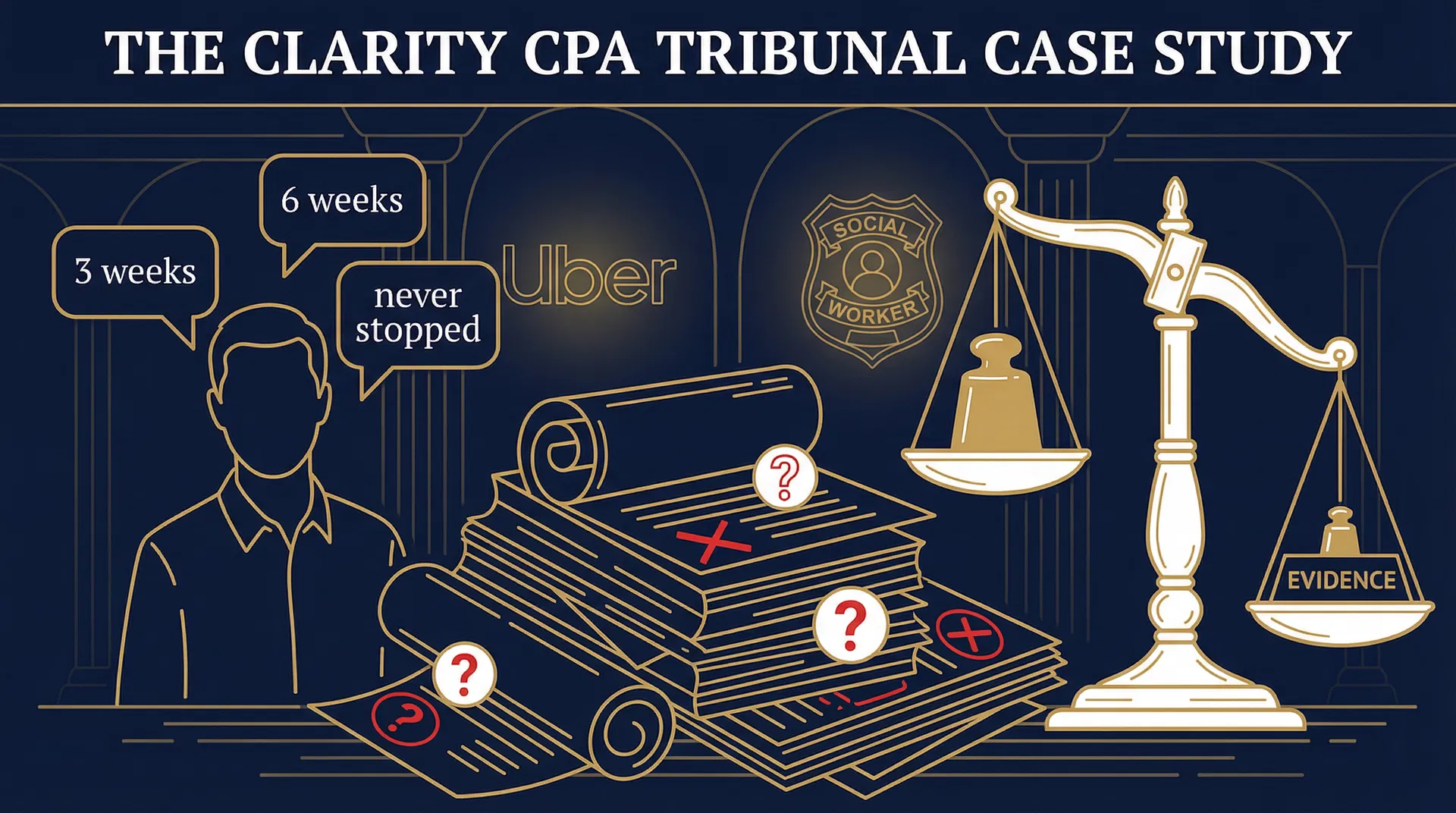
He produced zero income documentation to support this claim.
No pay records. No contract. No invoices. No T4A. No bank deposits. No engagement letter. Nothing. He said he was a self-employed social worker, and the Tribunal was just supposed to take his word for it.
Here's the thing about self-employment claims in an IRB context: words are not evidence. You can tell every assessor in Ontario that you were earning income as a social worker, but unless you can show the paper trail — what you were paid, when, by whom, and how it was reported — you have a story, not a claim. The adjudicator found exactly that: the applicant had not met his burden of proving on a balance of probabilities that he was self-employed as a social worker before the accident.
And the burden of proof sits squarely on the applicant. The insurer doesn't have to disprove your income. You have to prove it.
Two Ways the Lawyer Could Have Verified the Social Worker Income
This is the part that's hard to understand from a file-preparation standpoint. Even if the applicant didn't have personal records of his social worker income, verification wasn't impossible. Two practical options:
First, the lawyer could have sent a written request directly to Kerry's Place — the organization where the applicant claimed to work — asking them to confirm the engagement, the nature of the work, the pay rate, and the period of service. Employers and contracting organizations routinely respond to these requests from legal counsel, partly because they want to cooperate and partly because they know that ignoring a lawyer letter can invite more formal (and more expensive) legal processes. A simple confirmation letter from Kerry's Place would have gone a long way.
Second, under Ontario employment standards and common law, organizations that engage workers — whether as employees or independent contractors — are generally obligated to provide records of compensation upon request. The lawyer could have formally requested pay records, invoices, or any other documentation of the working relationship. Even a few bank deposit records matched to payments from Kerry's Place would have established something. Instead, the file went to hearing with nothing.
The Accountant Saw What Wasn't There
Here's a detail that speaks volumes: the applicant's own accountant prepared an IRB calculation. But that calculation was based only on Uber driving income. Not social worker income.
Why? Almost certainly because there were no supporting documents to verify any social worker earnings. An accountant preparing an IRB report works from source documents: tax returns, NOAs, T4s, T4As, bank statements, invoices, contracts. If none of those documents showed social worker income, the accountant couldn't include it. And they didn't.
This is actually the accountant doing their job properly — you don't fabricate a number you can't support. But it also means the applicant's own expert effectively confirmed that the social worker income claim had no documentary foundation. The report and the applicant's testimony were telling two completely different stories.
The Credibility Damage
And this is where the real harm was done — not just to the social worker claim, but to the entire file. When an applicant tells assessors one thing, tells the Tribunal another, and their own accountant's report contradicts both, the adjudicator stops trusting anything.
The applicant gave different accounts of when he returned to work to virtually every person who asked: three weeks after the accident to one assessor, four weeks to another, "not working" to a third, reduced hours to a fourth, and full-time after six to eight weeks to yet another. In a personal injury file, return-to-work timing is not a minor detail. It's a central fact. When that fact changes every time it's told, credibility collapses — and with it, the entire claim.
The Uber Mystery: A Number With No Visible Foundation
Now here's the part that genuinely puzzles me.
The applicant's accountant calculated IRBs at $253.06 per week based on the applicant's Uber driving income. Fine. But the adjudicator notes that the applicant made no submissions regarding his self-employment as an Uber driver. No argument about what his essential tasks were as an Uber driver. No argument about whether the accident caused a substantial inability to perform those tasks. And — critically — no apparent supporting documents submitted to the Tribunal.
So how did the accountant arrive at $253.06? What was the calculation based on? Presumably the accountant had something — a 2019 tax return, an Uber tax summary, maybe bank statements — because a reputable accountant wouldn't produce a number from thin air. But if those documents existed, they apparently weren't put before the Tribunal as part of the applicant's submissions.
And here's the kicker: Uber makes this easy. You can download annual tax summaries, trip earnings reports, 1099-equivalent documents, and detailed payment breakdowns directly from the Uber platform. It is almost impossible to be an Uber driver and not have access to quality supporting documentation. The platform generates it for you. So why wasn't it submitted?
The adjudicator also noted that the applicant told his own accountant he returned to Uber driving immediately after the accident. If that's true, it's hard to argue you suffered a substantial inability to perform the essential tasks of your self-employment — which is a requirement for IRB entitlement under s. 5(1) of the Schedule. Returning to work immediately is, by definition, not being unable to work.
The Bottom Line: A Case That Doesn't Add Up
This is an odd file. The applicant claimed income from social work but had no documents to prove it. His own accountant couldn't include it in the IRB calculation — presumably because those documents didn't exist. The accountant did calculate an IRB based on Uber income, which suggests supporting documents were available at some point, but those documents apparently weren't submitted to the Tribunal either. The applicant gave a different return-to-work timeline to nearly every person who asked. And in the end, the Tribunal dismissed entitlement to IRBs entirely — essentially because there was a calculation that produced a number ($253.06/week), but no actual evidentiary foundation underneath it.
A number without documents is just a number. And a claim without proof is just a story.
Suggestions for Practitioners: How to Avoid This Outcome
These aren't tips for "winning" — they're suggestions for getting the file right, which is what serves everyone.
Document the income before you argue about the disability. Before any IRB claim goes to hearing, verify that the supporting documents — tax returns, NOAs, T4/T4A slips, bank statements, contracts, Uber tax summaries, invoices — are actually in the file and will be submitted as evidence. An accountant's calculation is only as strong as the source documents behind it. If the documents exist but aren't submitted, the best calculation in the world is just an unsupported opinion. Build the evidentiary foundation first, then build the argument on top of it.
Reconcile the client's narrative with the documentary record early. If a client says they earned income from two sources but the tax return only shows one, that discrepancy needs to be addressed long before a hearing — not discovered by the adjudicator in real time. Sit down with the client, compare their story to the documents, and resolve inconsistencies before they become credibility problems. If the social worker income was real, get the records from the employer. If it wasn't real, don't claim it. Either way, the narrative and the documents need to match.
If your client was an Uber driver, submit the Uber records. This one's almost too obvious to say, but apparently it needs saying. Uber provides downloadable tax summaries, annual earnings reports, and trip-level data. These are high-quality, platform-generated documents that are hard to dispute. If your client's IRB claim is based on Uber income, download them, include them, and make sure your accountant references them explicitly. There is no good reason for an Uber-based IRB calculation to go to hearing without the underlying Uber records attached.
This post is written from the perspective of an independent forensic accountant. The goal is accuracy and proper file preparation — not advocacy for either side.