Kfouri v. TD General Insurance Company
When Tax Filings and IRB Claims Tell Different Stories
A Brief Decision With a Lasting Principle
This is a brief decision, but it delivers a principle that applies to virtually every self-employed IRB file: the way you report your income to the CRA is the way your IRB will be calculated. Full stop.
Background
The applicant was injured on February 6, 2019 when she slipped while entering her vehicle in a commercial parking lot. Both parties agreed she was entitled to Income Replacement Benefits for the period from February 13, 2019 to April 14, 2021. Disability was not in dispute. Entitlement was not in dispute. The sole issue before the Tribunal was the weekly quantum of the IRB.
The positions were far apart. The applicant claimed entitlement to $989.08 per week. The insurer calculated the benefit at $80.77 per week. The difference came down to a single classification question: was the applicant employed or self-employed?
The Applicant's Position
The applicant submitted that she was an employee of a limousine company owned by her husband. On that basis, she argued that her IRB should be calculated using the employment formula — which, applied to her claimed income, produced the $989.08 figure.
The Documentary Record
The difficulty with that position was that the applicant's own tax filings contradicted it entirely.
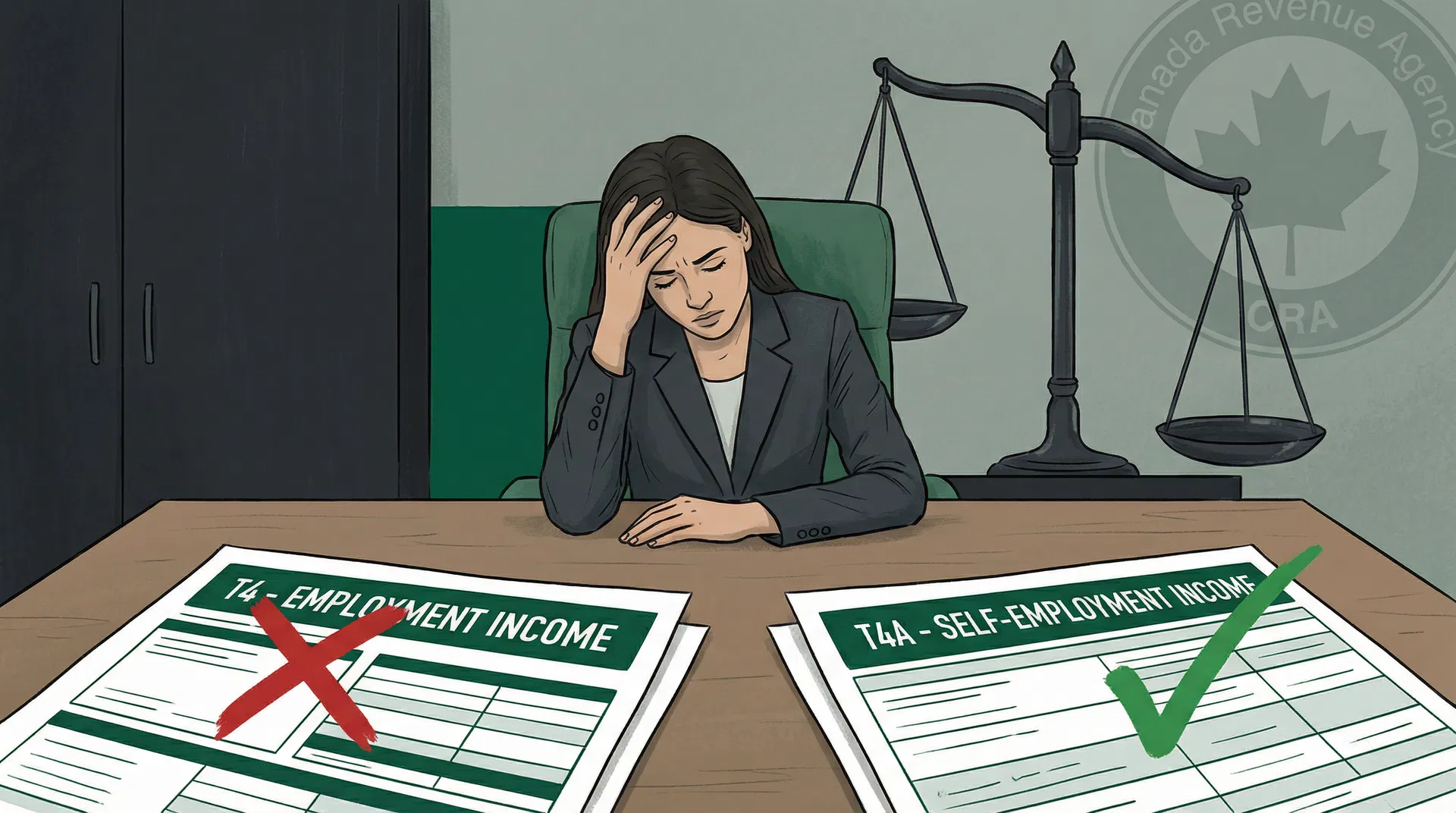
She reported no employment income to the CRA. Her payments from the limousine company were infrequent and had no source deductions: no CPP, no EI, no income tax withheld. The income was reported on a T4A ("Statement of Pension, Retirement, Annuity, and Other Income"), which is the form associated with self-employment and contract income. Had she been an employee, the appropriate form would have been a T4 ("Statement of Remuneration Paid"). No T4 was issued.
Her personal income tax returns reflected only self-employment income. That is what she reported to the CRA, and under s. 4(5) of the Schedule, IRB payments are calculated based on income as reported to the CRA.
The adjudicator was direct: the applicant's position "fails to appreciate that she reports income as earnings from self-employment only."
The Calculation
Once the Tribunal determined the applicant was self-employed for IRB purposes, the calculation followed from the documents. Her gross income from self-employment for the last fiscal year prior to the accident was $6,000. That translates to $115.38 per week in gross income. Applying the 70% IRB rate yields $80.77 per week.
The applicant provided no evidence of additional losses, such as the cost of hiring a replacement worker, that might have adjusted the quantum. Accordingly, $80.77 was the final figure.
The Accounting Report Was Rejected
The adjudicator explicitly rejected the accounting report submitted on the applicant's behalf. The report assumed the applicant was an employee and offered no explanation for why it characterized self-employment income as employment income.
It is difficult to understand how that characterization was defensible given the facts of this case:
- The applicant received no T4, only a T4A
- There were no source deductions of any kind
- Payments from the limousine company were infrequent
- The company was owned by the applicant's husband
- Her tax returns reported zero employment income
- No payroll records existed
Every indicator in the documentary record pointed to self-employment. Building a calculation on the premise that this was employment income, without addressing any of that contrary evidence, produced a report the Tribunal could not rely on. It was not given reduced weight. It was rejected outright.
The Award Request
The applicant sought a penalty award against the insurer under s. 10 of O. Reg 664, arguing that TD unreasonably withheld IRB payments by relying on its accountant's repeated requests for additional documentation.
The adjudicator acknowledged that the insurer may have had enough information to initiate some level of payment. However, he found the withholding was not unreasonable in the circumstances, particularly given that the applicant had provided "an inaccurate account of her self-employment." The interest owing on overdue benefits was considered a sufficient consequence.
Practical Considerations
If a claimant's tax filings do not reflect their actual working arrangement, that discrepancy should be identified and addressed well before the IRB claim reaches a hearing, including exploring whether amended returns are appropriate.
An IRB accounting report must be built on the documentary record. If there is a basis for treating income differently than it appears on the tax return, that basis needs to be clearly stated, explained, and supported.
If you are the accountant preparing the report, your role is to follow the documents. If the documents all point in one direction and your report points in the other, expect the Tribunal to choose the documents.
This post is written from the perspective of an independent forensic accountant. The goal is accuracy and proper file preparation, not advocacy for either side.