Mears (Griffiths) v. TD General Insurance Company
When Self-Employment Losses Existed Before the Accident, You Can't Just Blame the Accident
The Setup
This case sits at an intersection that comes up more often than people think in IRB files: a claimant with both employment income and self-employment income, where the self-employment side was already losing money before the accident. The question isn't whether the applicant was injured or whether she's entitled to IRBs. Both sides agreed on that. The question is whether the losses from her business can be added to the IRB calculation as accident-related losses, and if so, how much.
The answer, according to the Tribunal: not without evidence of causation.
The Background
The applicant was injured in a car accident on April 22, 2016. She had two sources of pre-accident income:
- Employment income from her job as a health information professional at Toronto East General Hospital
- Self-employment income as the owner, operator, and sole shareholder of New Way Beauty Depot Limited, a hair salon
After the accident, she returned to her healthcare job in a reduced capacity from August 2016 to January 2017, then was unable to return at all. She ceased operations of the hair salon by May 31, 2017.
Both parties agreed she met the legal test for IRB entitlement for the period claimed. The only disputes were over the quantum of IRBs — specifically how to treat the self-employment losses.
The Accounting Battle: ADS vs. PWC
This case came down to a contest between two accounting reports, one from each side. Neither party called witnesses. The entire hearing turned on whose numbers were more reliable.
The applicant's accountant calculated total outstanding IRBs at $166,821.32, which included the self-employment losses from New Way Beauty Depot as part of the IRB quantum. The report relied on s. 4 and s. 7 of the Schedule, arguing that "70 per cent of the amount of the insured person's weekly loss from self-employment that he or she incurs as a result of the accident" must be added when calculating the IRB.
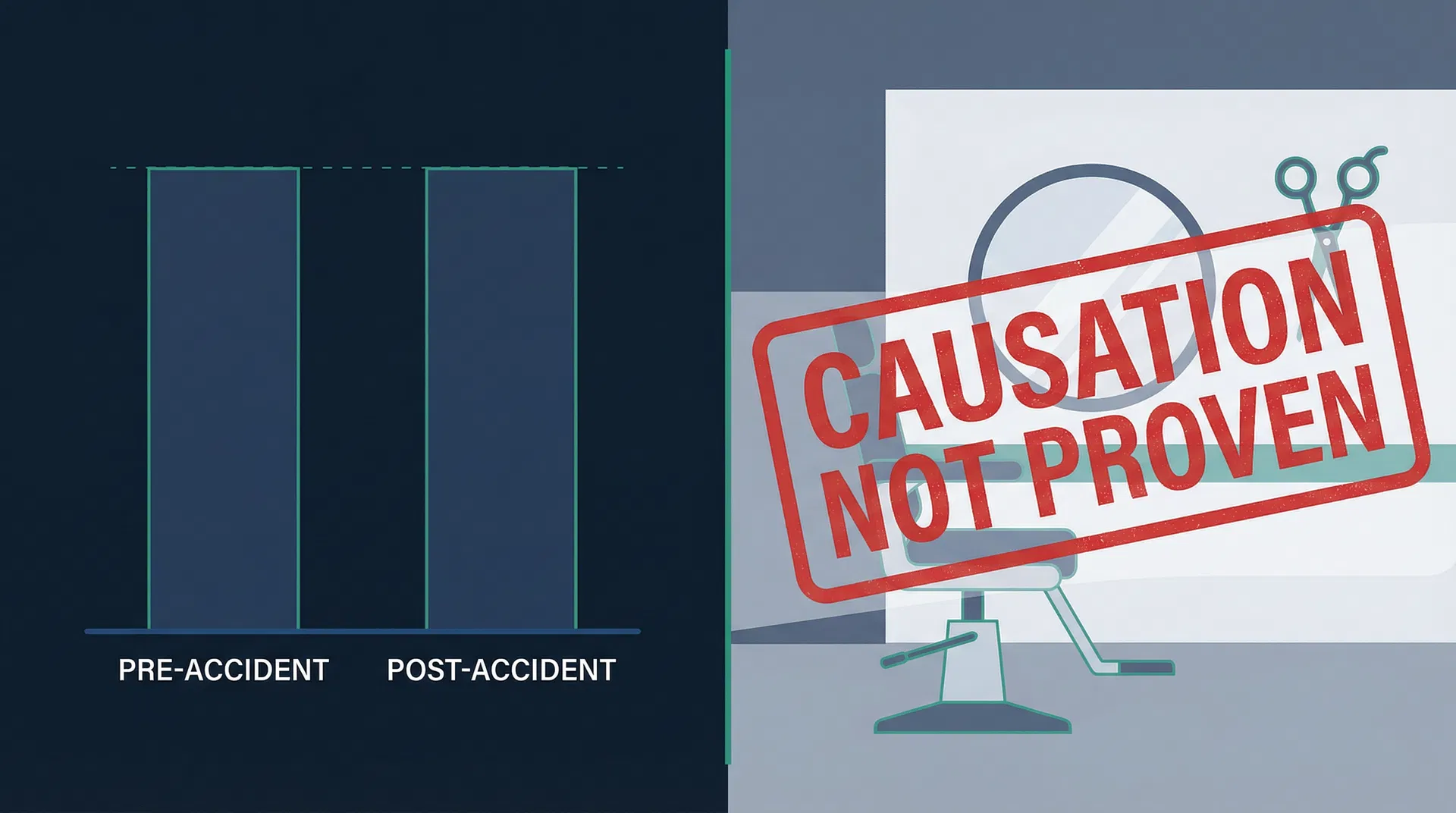
The insurer's accountant calculated total outstanding IRBs at $152,478.03. The critical difference: this report did not assign any accident-related value to the business losses. The reason was straightforward. The business was already operating at a loss before the accident, and the pattern of losses was essentially the same before and after.
The Numbers That Told the Story
Both accountants agreed on the underlying financial data. They only disagreed on what weight to give it in the IRB calculation. The numbers from the corporate tax returns showed:
| Period | Average Weekly Loss |
|---|---|
| Pre-accident (June 1, 2015 – May 31, 2016) | $670.29 |
| Immediate post-accident (April 23 – May 31, 2016) | $670.29 |
| Final fiscal year (June 1, 2016 – May 31, 2017) | $561.83 |
The pre-accident and immediate post-accident weekly losses were identical. The final year of operations actually showed a smaller weekly loss than the year before the accident. The financial trajectory of the business did not change in a way that pointed to the accident as a cause.
Where the Applicant's Case Fell Short
The Tribunal accepted, as a general principle, that the Schedule allows for a reasonably broad interpretation of how to assess self-employment losses for IRB purposes. That door was open. But the Tribunal also made clear that latitude is not unlimited. Any IRB calculation involving self-employment losses must be based on evidence demonstrating that those losses resulted from the accident.
The applicant did not provide that evidence. There was no testimony, no operational analysis, no expert explanation of how her injuries specifically caused the salon to lose money or shut down. There were only financial records — and those records showed a business that was losing money at roughly the same rate before and after the accident.
The Tribunal put it plainly: even if one wanted to assign some value to the accident's impact on the business, it would be impossible to determine a number with any accuracy because no evidence was presented showing how or why the business suffered losses as a result of the applicant's injuries.
The Applicant's Accounting Report: A Missed Opportunity
The Tribunal noted a specific deficiency in the applicant's accounting report that is worth highlighting. The report referenced various FSCO and LAT decisions to support its methodology for calculating self-employment losses. However, none of those decisions were actually submitted for the Tribunal's consideration, and the report did not include proper legal citations.
The Tribunal found this unhelpful.
This is a practical lesson for any accountant preparing an IRB report that involves self-employment losses. If your report relies on case law to support the methodology you've used, those cases need to be properly cited and, ideally, included in the evidence package so the Tribunal can review them. Referencing decisions without providing them leaves the adjudicator with no way to evaluate whether those authorities actually support the position being taken. The report effectively asked the Tribunal to trust the accountant's interpretation of the law without giving the Tribunal the tools to verify it.
Beyond the citation issue, the more fundamental gap was the absence of a causation analysis. The report included the self-employment losses in the IRB calculation but did not bridge the evidentiary gap between "the business lost money after the accident" and "the business lost money because of the accident." When the financial records show the business was losing money at a comparable rate before the accident, that bridge needs to be built with something more than the numbers alone. Operational context, staffing changes, client volume data, revenue trends tied to the applicant's reduced capacity — any of these could have helped establish that the accident caused or worsened the losses. None were provided.
The Result
The applicant was awarded $152,478.03 in past IRBs, in accordance with the insurer's accountant's report. The self-employment losses from New Way Beauty Depot were not included in the IRB quantum because the applicant did not establish that they were caused by the accident.
Practical Observations
Self-employment losses require causation evidence, not just financial records. If a business was losing money before the accident at a similar rate to after the accident, the financial records alone will not establish that the losses are accident-related. The applicant needs to provide evidence explaining how the accident caused or increased the losses.
If the business was already unprofitable, prepare for the comparison. When the pre-accident and post-accident loss patterns are similar, the insurer's accountant will point to that consistency as evidence that the accident didn't cause the losses. The applicant's side needs to anticipate this argument and provide operational evidence — client volume changes, staffing gaps, reduced hours of operation — to demonstrate the accident's specific impact.
Accounting reports that reference case law must cite it properly and include it in the evidence. The Tribunal cannot evaluate authorities it hasn't been given. If your methodology depends on how a previous decision interpreted the Schedule, provide the decision.
When both accountants agree on the underlying numbers, the dispute becomes about methodology and weight. In those situations, the report that provides clearer reasoning, better sourcing, and a more defensible analytical framework is the one the Tribunal will prefer.
This post is written from the perspective of an independent forensic accountant. The goal is accuracy and proper file preparation, not advocacy for either side.