Nice Try, Counsellor: Zeineddine v. Economical Mutual Insurance Company
When You Try to Combine Two Different Rules to Create Eligibility That Doesn't Exist
What Happened
The applicant was in a car accident on January 20, 2020. He applied for Income Replacement Benefits of $170.18 per week. The problem? He didn't qualify under either of the two paths the Schedule provides.
Path 1: Employment. Under s. 5(1)(1), you need to have been employed at the time of the accident or employed for at least 26 of the 52 weeks before the accident. The applicant was not employed at the time of the accident and had only worked 7 of the 52 weeks. Not even close.
Path 2: Self-employment. Under s. 5(1)(2), you need to have been self-employed at the time of the accident. The applicant had stopped being self-employed on November 29, 2019, roughly two months before the accident. Door closed.
So neither path works on its own. What do you do?
The Creative Argument
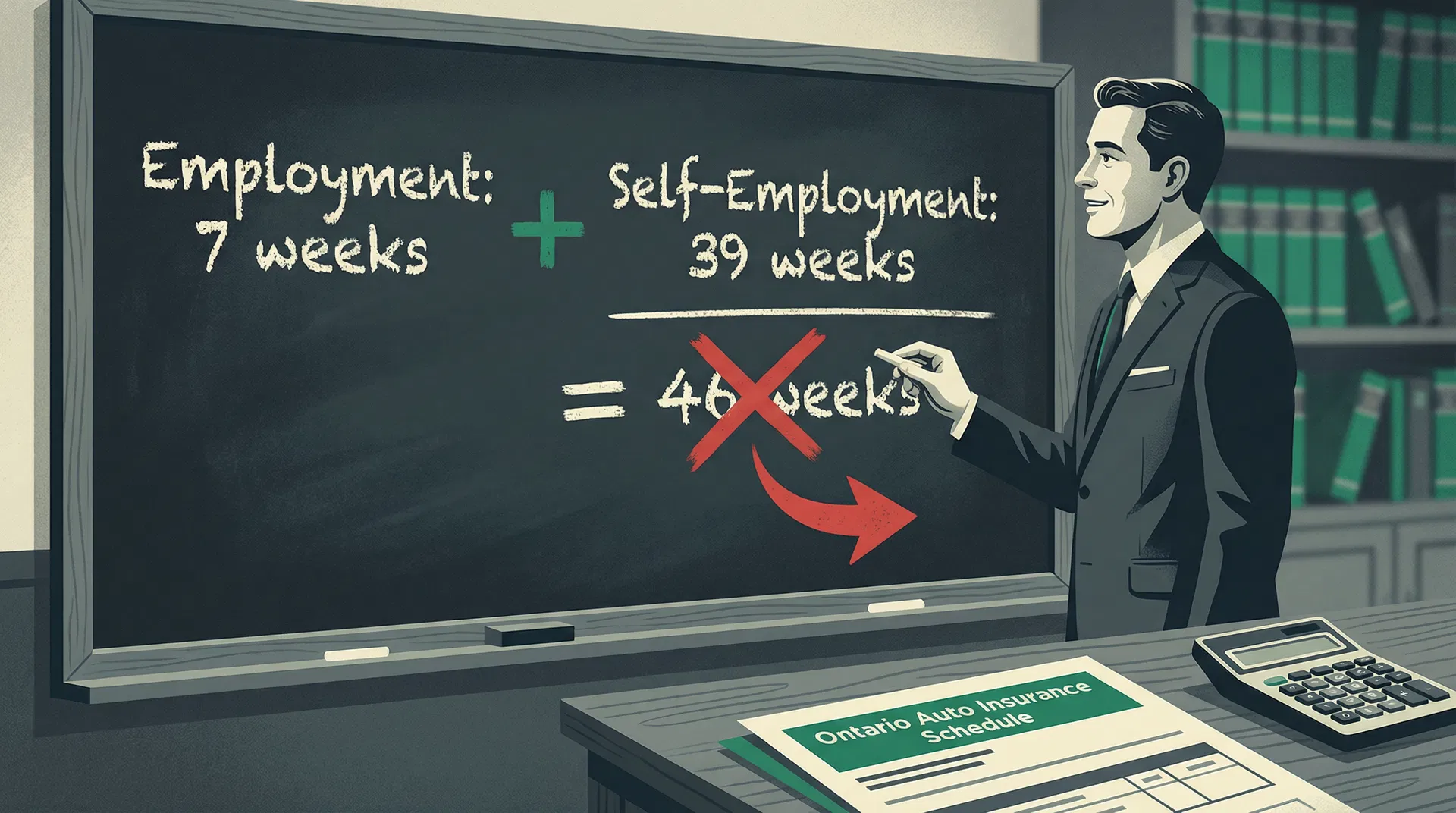
The applicant's lawyer tried to combine them. The argument was that the applicant's 39 weeks of self-employment should count toward the 26-week eligibility threshold under the employment provision. If you add the 7 weeks of employment and the 39 weeks of self-employment together, you get 46 weeks. That clears the 26-week bar easily.
The Schedule, however, doesn't work that way. The employment eligibility test and the self-employment eligibility test are separate and distinct provisions. They have different requirements, different thresholds, and different qualifying conditions. There is no provision in the Schedule that allows you to mix and match weeks from one category to satisfy the requirements of the other.
No case law was provided to support this interpretation. The Tribunal agreed with the insurer: the two tests cannot be combined.
The Result
No IRB entitlement. The applicant didn't qualify under employment rules. Didn't qualify under self-employment rules. And you can't stitch the two together to create eligibility that the legislation doesn't provide for.
Worth noting: the applicant actually won on almost everything else in this case. He got removed from the MIG based on a concussion diagnosis, won several treatment plans, and even got his accountant's report paid for under s. 7(4) despite not being entitled to the IRB itself — because the Schedule only requires that you be applying for the benefit, not that you're entitled to it. So this wasn't a total loss by any means. But on the IRB question, the answer was clear.
Sometimes the rules are just the rules. And no amount of creative arithmetic changes the eligibility criteria written into the Schedule.
This post is written from the perspective of an independent forensic accountant. The goal is accuracy and proper file preparation, not advocacy for either side.