Zhu v. Co-operators General Insurance
When You Won't Show Your Tax Returns, Don't Expect a Cheque
The Setup
The applicant was in a car accident on April 25, 2022. Both sides agreed he was disabled enough to qualify for Income Replacement Benefits. That part wasn't even a fight. The only question was: how much per week?
He wanted $400/week, the maximum. Co-operators said: we'd love to calculate that for you, but you won't give us the documents we need to do the math.
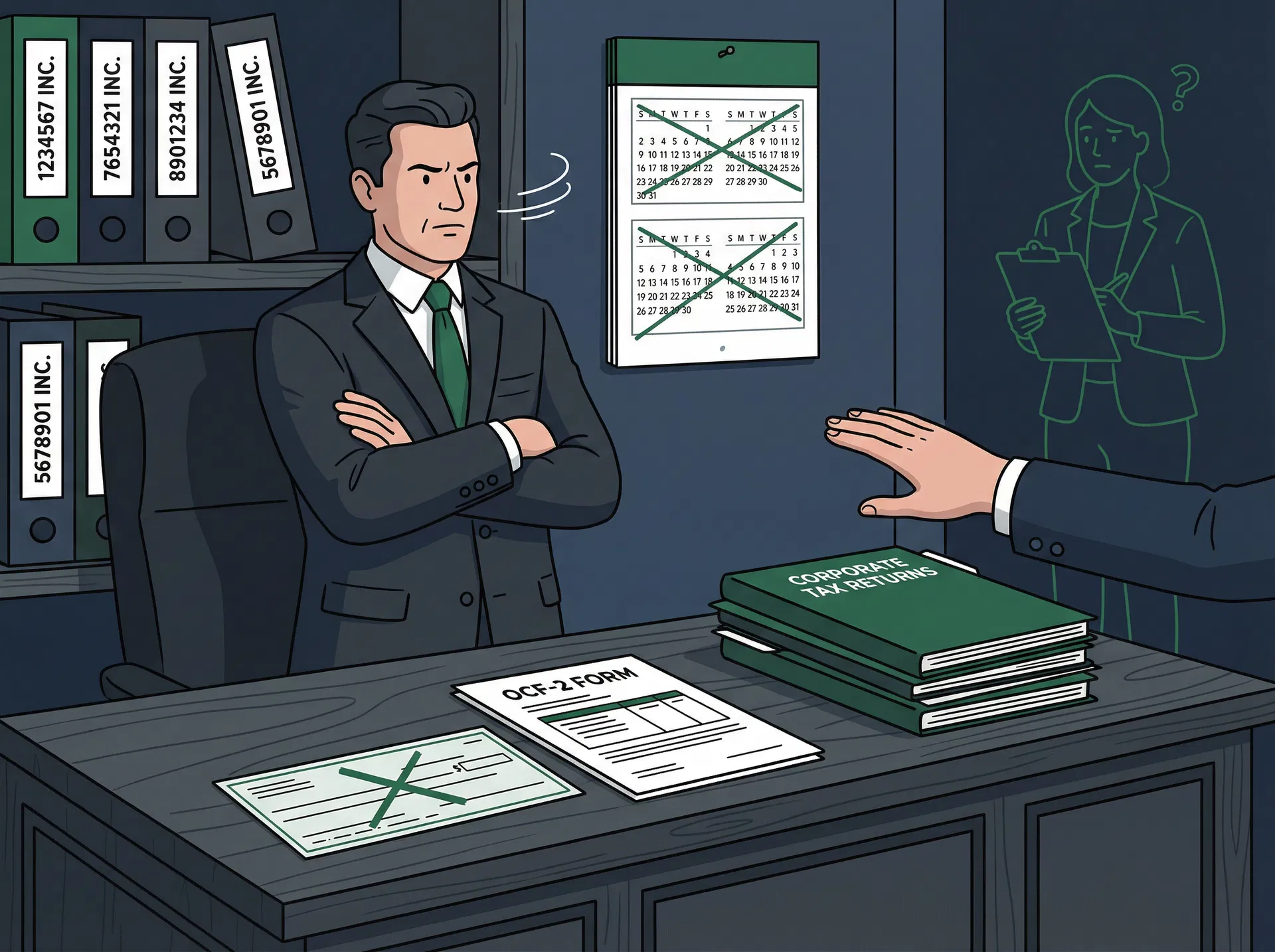
Two and a half years of requests later, the Tribunal sided with the insurer. No IRBs paid. Not because he wasn't injured. Not because he wasn't disabled. Because he wouldn't open his books.
The Self-Employment Structure
The applicant was self-employed. He owned a company called Wenfa Food Trading Inc., and he also had interests in two numbered corporations. His 2022 tax documents showed $17,250 in employment income from Wenfa and $86,533 in business income split across the two numbered companies.
His position was simple: I submitted an OCF-2 (Employer's Confirmation Form) showing $1,125/week in salary from Wenfa. My 2021 Notice of Assessment shows $54,000 in employment income. My 2023 NOA shows zero. Clearly I lost income. Pay me $400/week.
The insurer's position was equally simple: you're self-employed with income from multiple corporations. An OCF-2 from your own company confirming your own salary isn't enough. We need the financial records from all your income sources, pre-accident and post-accident, so we can actually calculate what you're owed under the Schedule. You've given us almost nothing despite roughly 20 requests over two and a half years.
Why the OCF-2 Wasn't Enough
This is where a lot of self-employed claimants trip up. When you're an employee at someone else's company, an OCF-2 carries weight because it's your employer independently confirming what they paid you. When you own the company that's filling out the OCF-2, you are essentially confirming your own salary to yourself. The document exists, but its evidentiary value is thin.
More importantly, the Schedule requires insurers to calculate IRBs for self-employed people using a specific formula under s. 7(2): 70% of the amount by which gross weekly employment and self-employment income exceeds any weekly loss from self-employment, capped at $400. And under s. 7(3), the insurer can deduct 70% of any self-employment income earned during the IRB period.
That formula requires real financial data, not just a top-line salary number from one of four corporations. The insurer needed income and expense information from all sources, for both the pre- and post-accident periods. Without it, the math simply cannot be done.
Section 33: The Rule That Bit Him
Section 33(1) of the Schedule requires an applicant to provide information reasonably required to help the insurer determine entitlement to a benefit. Sections 33(6) and 33(8) say that if you don't comply, the insurer doesn't have to pay during the period of non-compliance.
Co-operators denied the IRB under s. 33 non-compliance as early as July 7, 2022 and told the applicant, repeatedly, that they'd reconsider once the documents arrived. They even brought in a forensic accounting firm to assist with the calculation. The documents never came.
The adjudicator reviewed the approximately 20 requests sent between May 2022 and December 2024 and found every single one of them reasonable. They all related to confirming income and expenses for the relevant periods, exactly the kind of information you need to calculate a self-employed person's IRB.
The applicant made no specific submissions explaining why he didn't provide the requested information. He just argued that the OCF-2 and NOAs should be enough. They weren't.
Post-104 Week IRBs: A Different Test, Same Result
The applicant also wanted IRBs beyond 104 weeks. That's a higher bar. You need to show a complete inability to engage in any employment or self-employment for which you're reasonably suited. Not just your pre-accident job. Any suitable work.
His own psychological progress report from January 2024 indicated he had returned to work. The insurer's psychologist concluded he didn't meet the post-104 threshold. The applicant pointed to no medical evidence beyond January 2024 supporting complete inability. Case closed on that front too.
The Real Takeaway: Pre-Accident Tax Returns Open Doors
This is fundamentally a straightforward case. When your pre-accident tax returns show income flowing from multiple corporations, you've revealed the scope of your financial picture. The insurer is then entitled, and frankly obligated, to obtain evidence of income from all of those sources in the post-accident period to properly calculate the IRB amount.
You can't show the insurer a 2021 NOA with $54,000 in employment income plus $86,533 from two numbered companies and then refuse to provide the financial records behind those numbers. The NOA itself opened the door. The insurer walked through it. The applicant tried to slam it shut.
The SABS is consumer protection legislation, and it should be interpreted generously toward injured people. But "consumer protection" doesn't mean "no evidence required." It doesn't override the basic expectation that a claimant provide the financial information needed to calculate the benefit they're claiming. The Schedule has a built-in mechanism for this — s. 33 — and it has teeth. If you don't comply, the insurer doesn't pay. That's not the insurer being difficult. That's the legislation working as designed.
The Uncomfortable Truth About Corporate Records
There's a reality in self-employed IRB claims that doesn't get discussed enough: sometimes claimants don't refuse to produce corporate records because they don't have them. They refuse because they don't want to share them.
Maybe they have business partners who don't want the company's financials handed over to an insurance company. Maybe the claimant feels it's too intrusive. They got hit by a car, and now a forensic accountant wants to comb through their corporate books? Maybe there are things in the financials that are unflattering or complicated and the claimant would rather just not go there.
Those are all understandable human reactions. But they don't change the legal reality. If your IRB claim is rooted in self-employment income and you won't produce the tax returns, NOAs, and corporate financial records that substantiate it, you will almost always end up with no entitlement to IRBs. Not because the Tribunal is unsympathetic, but because there is literally no basis on which to calculate the benefit. A number needs inputs. No inputs, no number. No number, no cheque.
This post is written from the perspective of an independent forensic accountant. The goal is accuracy and proper file preparation, not advocacy for either side.