Omoruyi v. TD General Insurance Company
The Province of Ontario Likes Employees Better Than Entrepreneurs, I Guess?
The Setup
This case follows the law as the adjudicator interpreted it. The reasoning is thorough and the case law cited supports the result. But the result is that a personal support worker who was earning a solid income right up until her accident received an IRB of exactly zero dollars per week.
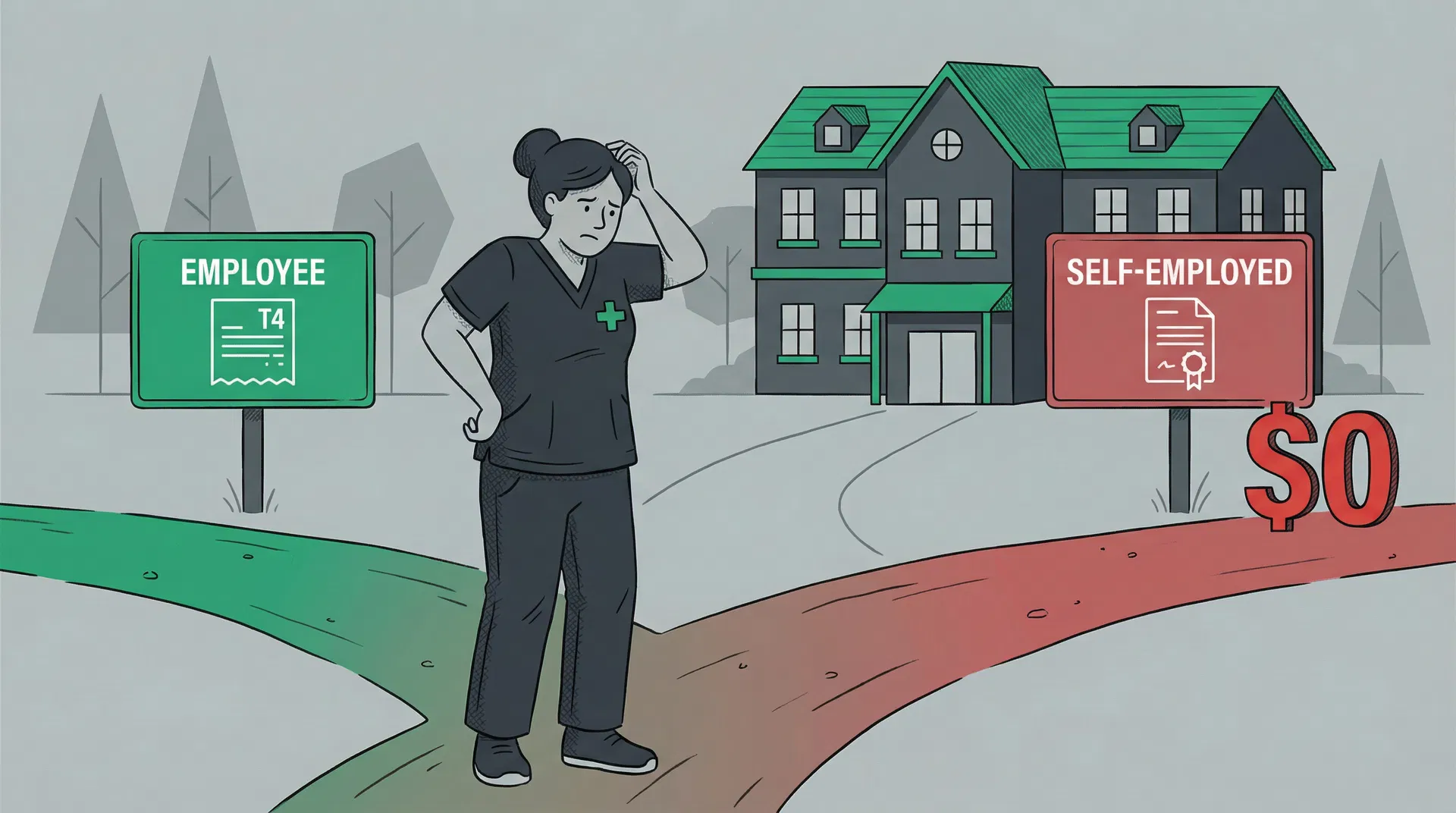
Not because she wasn't injured. Not because she wasn't disabled. Not because she wasn't working. But because the Schedule's formula for self-employed people, applied to the specific timing of her transition from employment to self-employment, produced a number that is mathematically and practically zero.
Whether the law had to produce that result is a different question, and one worth examining.
The Background
The applicant worked as a certified personal support worker at the Perth Community Care Centre in Perth, Ontario, starting in September 2021. For the first year and a half, she was an employee of BHA Placement Network Inc., the staffing agency that placed her at the care centre. BHA handled everything you'd expect for an employee: they withheld income taxes, remitted CPP and EI, and paid her directly. Her 2022 employment income from BHA was $99,201.
At the end of 2022, BHA exited the business. The applicant was told she'd need to find a new staffing agency. She selected SugiCare Staffing Corp., which was taking over PSW staffing at the same care centre.
SugiCare required, as a condition of working for them, that each PSW register a business. The applicant was told she'd be paid similarly to what she earned under BHA, but SugiCare would not provide benefits, would not withhold income taxes, and would not handle CPP or EI remittances. The applicant registered an Ontario business called Josessyjo on December 16, 2022, and started the new arrangement with SugiCare on January 1, 2023.
Nothing else about the work changed:
- Same job at the same facility
- Same duties and responsibilities
- Same supervision by the care centre's nursing staff
- Same schedule managed by the care centre
The only difference was the label and the payroll structure. She went from "employee" to "independent contractor" because a staffing agency required it.
On October 13, 2023, she was in a car accident.
The IRB Claim
The applicant applied for Income Replacement Benefits at $400 per week. Both sides agreed she was disabled and unable to perform the essential tasks of her job for a period after the accident. The sole dispute was quantum: how much per week was she owed?
That question turned entirely on whether she was "employed" or "self-employed" under the Schedule, because the two classifications use completely different formulas to calculate the weekly IRB amount.
The Classification Fight
The applicant argued she was an employee. Her evidence was practical:
- Her job activities before and after registering the business were identical
- Her schedule and daily tasks were directed by the care centre, not by her
- She didn't work for any other clients
- She didn't collect or remit HST
- Her paycheques were made out to her personally, not to her business
- She didn't file a Statement of Business Activities or claim business expenses
- SugiCare itself provided an OCF-2 (Employer's Confirmation Form) identifying her as an employee
The insurer argued she was self-employed. Their evidence was more formalistic:
- She registered a sole proprietorship in December 2022
- SugiCare did not withhold taxes or remit CPP/EI
- SugiCare's managing director confirmed in writing she was an "independent contractor"
- Her 2023 tax return identified her income as "self-employed commissions"
- She did not receive a T4 from SugiCare
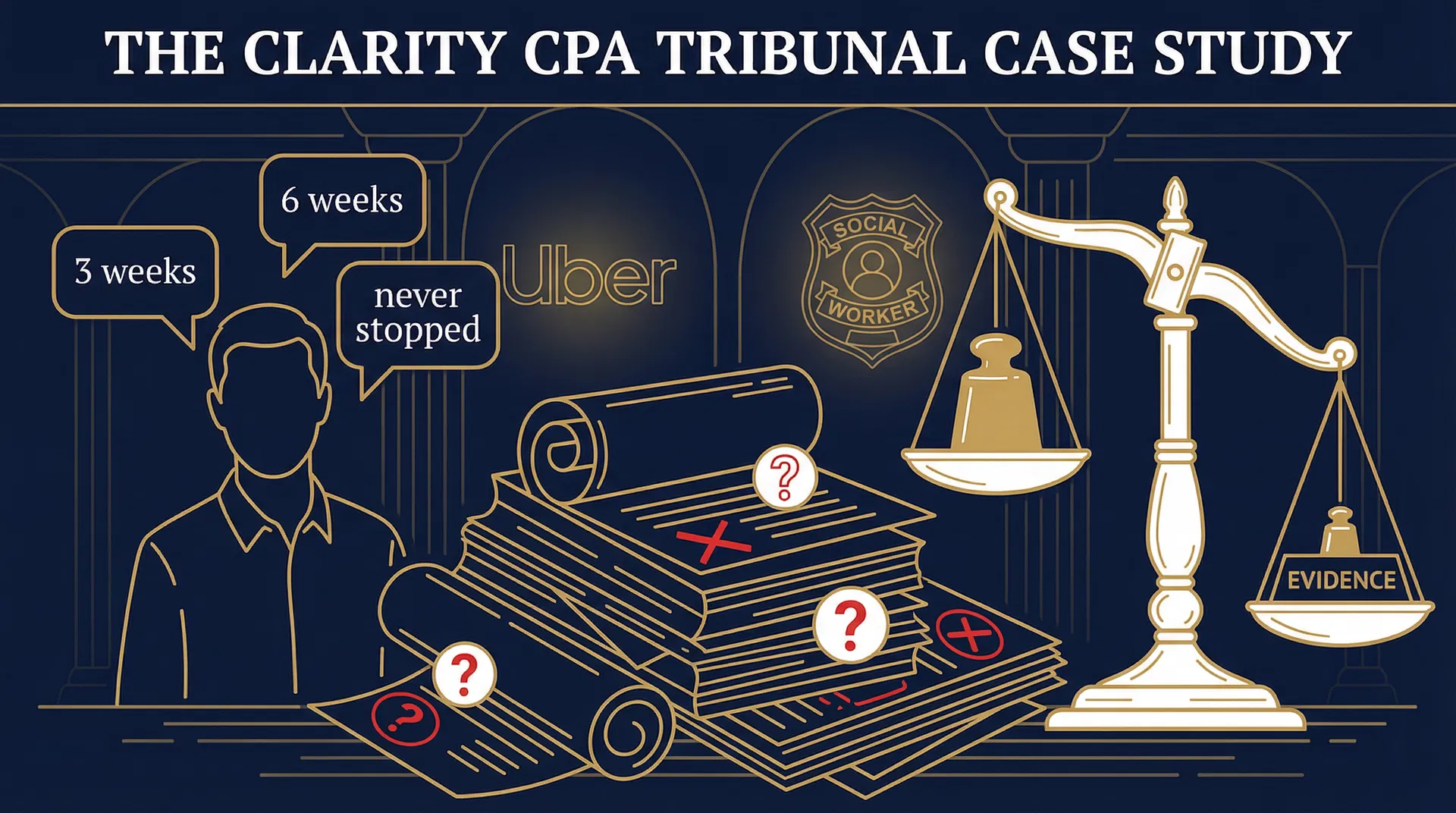
The adjudicator sided with the insurer. Under the 2016 amendments to the Schedule, the definitions of "self-employed person" and "self-employment" are written into s. 3(1). A self-employed person includes someone who engages in an occupation as a sole proprietor. The applicant registered a sole proprietorship. She filed her taxes accordingly. SugiCare treated her as an independent contractor. The CRA accepted her filing as self-employment income.
The adjudicator found that the pre-2016 "factual indicia" approach (examining supervision, control, tools, and integration) was no longer the governing framework under the current Schedule, and the applicant's subjective belief that she was an employee was not persuasive against the documentary record.
A Contrast Worth Noting: Salmon v. Sonnet Insurance Company
It is worth pausing here to consider the Tribunal's decision in Salmon v. Sonnet Insurance Company (2025 ONLAT 24-013201), which we covered in a previous post.
In Salmon, the applicant also had no T4. He was paid by a third-party employment agency. No source deductions were taken. The name on his paycheque didn't match the company he worked at. On paper, the indicators looked similar to a contractor arrangement.
But in that case, the Tribunal looked at the substance of the working relationship and found the applicant was an employee. He showed up where he was told, when he was told. He wore a company uniform. He used the company's tools. He was supervised daily. He received overtime pay. The employment agency's own representative testified that the lack of deductions was a mistake.
The facts in Omoruyi are strikingly parallel. The applicant performed the same job, at the same facility, under the same supervision, before and after the classification change. The only thing that changed was the staffing agency's administrative structure. Yet in this case, the adjudicator found that the 2016 Schedule definitions, rather than the factual substance of the relationship, controlled the classification.
It is logically difficult to reconcile the two approaches. In Salmon, substance overrode form. In Omoruyi, form overrode substance. Both decisions may be defensible on their specific facts and the arguments presented, but the divergence raises a question about whether the Schedule's definitions are producing consistent outcomes for workers in similar situations.
The Quantum Disaster
Under s. 4(3) of the Schedule, a self-employed person's weekly income for IRB purposes is calculated as 1/52 of the person's income from the business for the last completed taxation year before the accident.
The accident happened in October 2023. The last completed taxation year was 2022. The applicant's business, Josessyjo, was registered in December 2022 and did not begin operating until January 1, 2023. Its income in 2022 was zero.
The formula: 1/52 of $0 = $0 per week.
The applicant earned $99,201 in employment income in 2022. She earned $43,791 in self-employment income in 2023 before the accident. She was consistently earning income throughout the entire pre-accident period relevant to the Schedule. And yet, because s. 4(3) locks onto the last completed taxation year of the business, and that year preceded the business's operations, the number is zero.
What the Schedule Actually Says About Combining Income
There is a provision in the Schedule that the applicant's lawyer raised, and that warrants closer attention. Section 7(2)(1)(i) sets out how the weekly base amount for an IRB is calculated during the first 104 weeks of disability:
70 per cent of the amount, if any, by which the sum of the insured person's gross weekly employment income and weekly income from self-employment exceeds the amount of the insured person's weekly loss from self-employment
The language is explicit: "the sum of the insured person's gross weekly employment income and weekly income from self-employment." The section contemplates that a person may have both types of income and that both should be included in the IRB calculation.
The applicant's lawyer argued that this language should infer that the applicant's employment income from the same occupation, earned in the year immediately preceding the accident, should be included in the calculation. The applicant was performing the same work continuously. Her income stream from that work was uninterrupted. The only thing that changed was the classification label. If s. 7(2) directs the insurer to sum employment income and self-employment income when calculating the weekly base, the argument follows that employment income earned from the same occupation should not be excluded simply because the person was solely self-employed at the moment of the accident.
The adjudicator found that s. 7 provides the method for calculating the IRB amount but relies on s. 4 to define the bases for those calculations. Because the applicant was found to be solely self-employed, only s. 4(3) applied, and s. 4(3) pointed to the prior fiscal year's business income, which was nil.
Another Contrast: F.T. v. Co-operators
There is at least one Tribunal decision that took a different approach to the calculation question for a self-employed applicant. In F.T. v. The Co-operators, the Tribunal based the applicant's income using the prior 52 weeks when he was self-employed, rather than strictly applying the last completed fiscal year formula.
This creates an additional layer of inconsistency. If one adjudicator is willing to look at the 52-week pre-accident period for a self-employed person, and another requires strict adherence to the last completed fiscal year under s. 4(3), then similarly situated applicants may receive materially different outcomes depending on which adjudicator hears their case.
The Lawyer's Attempts
The applicant's lawyer made several arguments to avoid the zero-dollar result:
- Use the 2022 employment income under s. 4(2)3. The adjudicator found, relying on the binding Divisional Court decision in Waterloo Insurance v. Switzer, that this section only applies when the person was both employed and self-employed at the time of the accident. The applicant was solely self-employed. Section 4(2) did not apply.
- Use the 2023 self-employment income. The adjudicator found that s. 4(3) specifically directs the calculation to the last completed taxation year, not the current year. The 2023 tax year was not yet complete at the time of the accident.
- The absurdity argument. Under s. 7(3), the insurer can deduct 70% of any post-accident income from the IRB. The Schedule counts all income when it reduces the benefit but, in this interpretation, refuses to count all income when it establishes the benefit. The lawyer argued this was absurd. The adjudicator acknowledged the argument but found the statutory language was clear.
- Case law supporting inclusion of employment income. The lawyer cited V.H. v. Aviva and K.D. v. Aviva. The adjudicator found both cases actually reinforced the narrow interpretation.
The lawyer was thorough and persistent. Every available avenue was explored. The arguments about the remedial nature of the Schedule, the absurdity of a formula that produces zero for someone who was consistently earning income, and the unfairness of a classification that was imposed rather than chosen are legitimate concerns that deserve attention from the legislature. But under the current state of the law, the adjudicator found no authority to override the plain language of s. 4(3).
The Reconsideration
The applicant requested reconsideration. On one point, she succeeded: the adjudicator agreed to vacate all findings related to medical entitlement to IRBs, because the insurer had filed its expert reports late (breaching Rule 10.2) and there had been an agreement between the parties that the hearing would address quantum only.
On the quantum findings, the reconsideration request was dismissed. The adjudicator found that the applicant's submissions were proposing a re-weighing of evidence already considered, not identifying errors of law. The IRB quantum remained at zero.
The Broader Context
This case sits within a pattern that is worth observing:
- Ontario's auto insurance system has been progressively reducing the scope and generosity of accident benefits over the past decade. IRB coverage is now becoming optional in many policy configurations.
- The maximum weekly benefit has not been meaningfully updated.
- The Schedule's formulas for self-employed people continue to produce outcomes that, in specific factual scenarios like this one, result in zero entitlement for people who were clearly earning income and clearly unable to work.
- The gig economy, staffing agency models, and the growing prevalence of "independent contractor" arrangements mean that more Ontario workers are being classified as self-employed, often not by choice but by the terms imposed on them as a condition of working.
- The 2016 definitions of self-employment are clear and unambiguous, but they do not account for the reality that a person can be functionally an employee in every meaningful sense while being legally a sole proprietor because a staffing company required them to register a business.
Whether the gap exposed by this case is a policy choice or an unintended consequence is a question for the legislature. But for the workers caught in it, the financial consequences are significant.
Practical Observations
If a client transitioned from employment to self-employment shortly before an accident, the timing of that transition relative to the last completed taxation year is critical. Under s. 4(3), the IRB calculation is locked to the prior fiscal year's business income. If the business had no income in that year, the quantum is zero regardless of what the person actually earned.
The 2016 definitions of "self-employed person" in s. 3(1) of the Schedule have largely replaced the older "factual indicia" approach. Arguments based on supervision, control, and integration, while intuitively compelling, may not succeed if the documentary record (business registration, tax filings, T1 classification) points to self-employment. However, contrasting decisions like Salmon suggest the approach is not universally consistent across adjudicators.
Section 7(2)(1)(i) explicitly contemplates summing employment income and self-employment income in the IRB calculation. Whether this provision can be used to include prior employment income for a solely self-employed applicant remains an open question that may benefit from further litigation or legislative clarification.
If a client was both employed and self-employed at the time of the accident, s. 4(2)3 may allow them to designate employment income from the prior fiscal year. But per Waterloo v. Switzer, this option is only available if the client actually meets the employment eligibility criteria under s. 5(1)1.
This post is written from the perspective of an independent forensic accountant. The goal is accuracy and proper file preparation, not advocacy for either side.